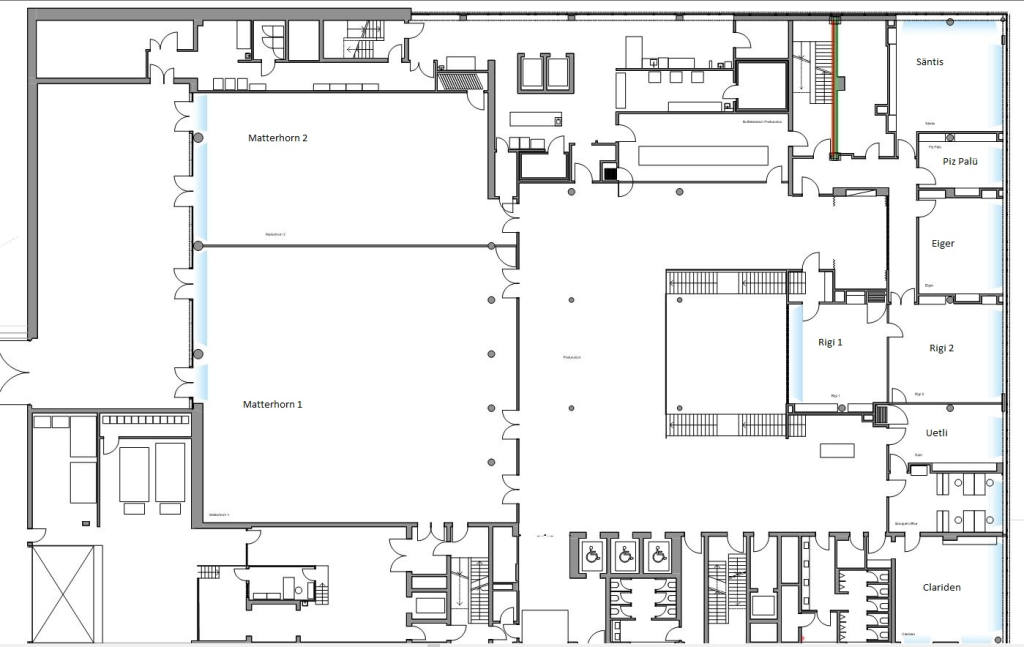

| Time | Title/Session | Presenter |
|---|---|---|
| 09:00–10:30 | Opening Plenary & Rules of Engagement (Mattherhorn 1) | Volker Wulfmeyer and Nathaniel Chaney |
| 10:30–11:00 | BREAK | |
| 11:00–12:30 | Poster Sessions (Matterhorn 2) For the Poster Presentation Overview click here | |
| 12:30–13:30 | LUNCH | |
| 13:30–18:00 | Oral Sessions |
Oral Presentations Matterhorn 1
Theme 3
Rethink the modeling of land-atmosphere interactions using advanced process understanding, benchmarking, and machine learning
| Time | Title | Presenter |
|---|---|---|
| 13:30–13:45 | Analyzing Land-Atmospheric Feedback Dynamics Using Machine Learning | Martin Butz |
| 13:45–14:00 | Hybrid machine learning of ecosystem water access reveals divergent vegetation – water coupling behavior | Georgios Blougouras |
| 14:00–14:15 | Hybrid Modelling for Coupled Water and Carbon Dynamics: Field-scale Diagnostics of Plant Water Use Efficiency | Yuji Shigefuji |
| 14:15–14:30 | Learning Hidden Soil Water Processes with Differentiable Hybrid Modeling | Sarem Norouzi |
| 14:30–14:45 | Machine Learning-Based Equation Discovery in Land-Atmosphere Modelling | Sanaa Hobeichi |
| 14:45–15:00 | From observations to improved land–atmosphere coupling via multi-scale constraints and machine learning | Markus Reichstein |
| 15:00–16:00 | Break |
Theme 1
Observing, understanding, and parameterizing turbulence and surface fluxes at the land-atmosphere interface
| Time | Title | Presenter |
|---|---|---|
| 16:00–16:15 | Understanding Sensitivity of Large Scale Models to Differences in Surface Layer Physics using Turbulence Anisotropy | Tyler Waterman |
| 16:15–16:30 | Oblique Flow Signatures in heterogeneous agricultural Land–Atmosphere Exchange: using the Elliptic model to analyze the wind and temperature fields from high-resolution Fiber-Optic Distributed Sensing | Juan Manuel Lopez-Vega |
| 16:30–16:45 | Validity of Taylor’s Hypothesis in a forest clearcut flow | Subharthi Chowdhuri |
| 16:45–17:00 | Scale effects on flux-variance relations in the urban roughness sublayer | Khaled Ghannam |
| 17:00–17:15 | What controls the normalized equilibrium surface temperature response to subsurface heating in an idealized subsurface-atmosphere configuration? | Patricia Glocke |
| 17:15–17:30 | Towards a macro-scale perspective of non-rainfall water inputs | Sinikka J. Paulus |
Oral Presentations Rigi 1
Theme 2
Advancing soil processes for understanding the soil-plant-atmosphere continuum: from bedrock to stomata
| Time | Title | Presenter |
|---|---|---|
| 13:30–13:45 | Towards a better representation of plant water availability in the Amazon and South America: Focus on deep root water uptake | Carolina Bieri |
| 13:45–14:00 | Characterizing plant hydraulic behaviour under drought stress using vegetation modelling | Zeyu Duanmu |
| 14:00–14:15 | Rooting out misrepresentation of water uptake in large-scale models | Dan Li |
| 14:15–14:30 | Towards Improved Land–Atmosphere Coupling in ecLand via a Unified Soil Hydro-Thermal Parameterisation | Rajsekhar Kandala |
| 14:30–14:45 | Sensitivity of simulated drought impacts to soil hydraulic parameters in the ICON-QUINCY land surface model | Francisco José Cuesta-Valero |
| 14:45–15:00 | Using Satellite Land Surface Data to Diagnose and Reduce Model Biases During Compound Hot–Dry Events: From Coupled ALARO–SURFEX to Offline SURFEX Experiments over Belgium | Sajjad Alghezi |
| 15:00–15:15 | Within-canopy profiles of air temperature, humidity, and CO2 concentration give novel insights into vegetation-atmosphere interactions and feedback | Pauline Seeburger |
| 15:15–16:00 | Break |
Theme 6
Representing anthropogenic influences in the water and energy cycles: Implications for surface and fluxes and PBL dynamics
| Time | Title | Presenter |
|---|---|---|
| 16:00–16:15 | Evaluating The Role of Agricultural Biophysical Function in the Atmospheric Boundary Layer | James Cross |
| 16:15–16:30 | Conducting the atmosphere : Irrigation-induced lightning activity over CONUS | Jonas Mortelmans |
| 16:30–16:45 | Detecting an externally forced signal in observed terrestrial water storage | Casimir Fisch |
| 16:45–17:00 | Idealized cover cropping modulates extreme temperatures in ICON-ESM | Leonore Jungandreas |
| 17:00–17:15 | Evapotranspiration Regime Transitions as a Mechanism for Amplified Heat Extremes in Europe | Tatiana Klimiuk |
Oral Presentations Rigi 2
Theme 4
Understanding and modeling the role of surface heterogeneity across all landscapes and climates
| Time | Title | Presenter |
|---|---|---|
| 13:30–13:45 | Investigations of ABL dynamics and structure over heterogeneous surfaces with turbulence-resolving simulations (LES) | Benita Wagner |
| 13:45–14:00 | Investigating the scale-dependency of land-atmosphere interactions: A comparative study of ICON-NWP and ICON-LES. | Deepam Jyoti |
| 14:00–14:15 | A lafge eddy simulation and artificial neural netword based approach to model CO2 transport through secondary circulations. | Luise Wanner |
| 14:15–14:30 | Understanding Urbanization’s Influence on Rainfall in Sydney Through High-Resolution Modeling | Shankar Sharma |
| 14:30–14:45 | Effects of improved subsurface hydrology in ICON on the simulation of surface and atmospheric fluxes | Morgane Lalonde |
| 14:45–15:00 | The role of mesoscale soil moisture heterogeneity in amplifying humid heatwaves | Guillaume Chagnaud |
| 15:00–16:00 | BREAK |
Theme 5
Investigations of boundary layer processes and land-atmosphere feedbacks including the role of cloud and precipitation
| Time | Title | Presenter |
|---|---|---|
| 16:00–16:15 | Soil Moisture Influence on Shallow Cumulus Mass Flux and Variability in Realistic Large-Eddy Simulations | Jaydeep Singh |
| 16:15–16:30 | Bridging cloud-vegetation interactions with climate implications | Hao Luo |
| 16:30–16:45 | Effects of Intercepted Precipitation on Convective Cold Pool Outflows | Aryeh Drager |
| 16:45–17:00 | Evaluating the diurnal cycle of precipitation across satellite and reanalysis datasets against global ground-based observations | Gyuyeon Choi |
| 17:00–17:15 | Cloud–Forest Coupling: New insights integrating Amazon Observations and Explicit Canopy-Cloud Simulations | Jordi Vila Guerau de Arellano |
| 17:15–17:30 | Wind shear enhances soil moisture influence on rapid thunderstorm growth | Christopher Taylor |
| Time | Session | |
|---|---|---|
| 09:00–10:30 | Oral Sessions (see schedule below) | |
| 10:30–10:30 | BREAK | |
| 11:00–12:30 | Poster Sessions (Matterhorn 2) For the Poster Presentation Overview click here | |
| 12:30–13:30 | LUNCH | |
| 13:30–15:30 | Town halls | |
| 15:30–16:00 | BREAK | |
| 16:00–18:00 | Oral Sessions (see schedule below) |
Oral Presentations Matterhorn 1
Theme 3
Rethink the modeling of land-atmosphere interactions using advanced process understanding, benchmarking, and machine learning
| Time | Title | Presenter |
|---|---|---|
| 09:00–09:15 | An integrated benchmarking framework identifies sources of error in climate models | Eunkyo Seo |
| 09:15–09:30 | Land surface model underperformance tied to specific meteorological conditions | Jon Cranko Page |
| 09:30–09:45 | A comparison of traditional and machine-learning methods: Land model calibration for 124 global flux tower sites | Ignacio Aguirre Belmar |
| 09:45–10:00 | Accounting for observation uncertainty in model evaluation: the observation range adjusted method | Jason Evans |
| 10:00–10:15 | How do we make our land models better? | Gab Abramowitz |
Theme 4
Understanding and modeling the role of surface heterogeneity across all landscapes and climates
| Time | Title | Presenter |
|---|---|---|
| 15:30–15:45 | A Framework to Evaluate and Develop Land Surface Models at km-scale resolution | Jan Polcher |
| 15:45–16:00 | A Simplified Land Surface Model to Assess the Representation of Land-Atmosphere Coupling with Surface Heterogeneities using a Hierarchy of Models | Frederique CHERUY |
| 16:00–16:15 | Land surface-atmosphere interactions simulated by the ICON atmospheric model | Jan-Peter Schulz |
| 16:15–16:30 | Recent Developments in Global Land Surface Model for the Next Seasonal Prediction System at JMA (CPS5) | Kenta Ochi |
| 16:30–16:45 | Impact of surface heterogeneity on urban modelling across scales | Denise Hertwig |
| 16:45–17:00 | Land-atmosphere feedback in urban environments: Sensitivity analysis of FPS-URB-RCC STAGE-0 sub-ensemble of WRF simulations | Josipa Milovac |
Oral Presentations Rigi 1
Theme 2
Advancing soil processes for understanding the soil-plant-atmosphere continuum: from bedrock to stomata
| Time | Title | Presenter |
|---|---|---|
| 09:00–09:15 | Emerging role of soil hydraulic conductivity curves on ecosystem water limitation | Andrea Carminati |
| 09:15–09:30 | Enhancing Simulation of Soil Moisture and Evaporation Fluxes in North America through Explicit Representation of Soil Organic Matter and Forest Litter | Nicolas Leroux |
| 09:30–09:45 | Impact of improved land surface soil organics representation on land-atmosphere interaction | Cenlin He |
Theme 1
Observing, understanding, and parameterizing turbulence and surface fluxes at the land-atmosphere interface
| Time | Title | Presenter |
|---|---|---|
| 15:30–15:45 | Sensitivity analysis of seasonal carbon and water fluxes to plant hydraulic parameters across European climate zones and PFTs in eCLM | Juan C. Baca Cabrera |
| 15:45–16:00 | Spatially Explicit Parameterization of the Forest Floor Organic Layer in Noah-MP: Impacts on Surface Energy Partitioning and Land–Atmosphere Coupling | Yayan Cui |
| 16:00–16:15 | Sensible and Latent Heat Flux Prediction with Deep Learning using twenty years of Falkenberg micrometeorological data | Anna Winkelmann |
| 16:15–16:30 | An Empirical Partitioning of Evapotranspiration Change into Soil-Moisture-Driven and Non-Soil-Moisture Pathways | Hsin Hsu |
Oral Presentations Rigi 2
Theme 4
Understanding and modeling the role of surface heterogeneity across all landscapes and climates
| Time | Title | Presenter |
|---|---|---|
| 09:00–09:15 | Modelling the functionally diverse Caatinga: insights into a unique tropical forest | Manon Sabot |
| 09:15–09:30 | Flux-Driven Surface Temperature Responses to Forest-Cropland Transitions in India Using the ICON Model | Jyoti Sharma |
| 09:30–09:45 | Exploring the role of tree cover heterogeneity on cloud formation across African landscapes | Gregory Duveiller |
| 09:45–10:00 | Life inside a grid cell… in a Virtual Ecosystem | Vivienne Groner |
Theme 3
Rethink the modeling of land-atmosphere interactions using advanced process understanding, benchmarking, and machine learning
| Time | Title | Presenter |
|---|---|---|
| 15:30–15:45 | Coordinated learning of soil pedotransfer functions through differentiable land surface modeling | Shijie Jiang |
| 15:45–16:00 | Emulating the land surface with aiLand: A Neural Network Approach to Weather and Climate Prediction | Nina Raoult |
| 16:00–16:15 | Forecasting diurnal land surface temperature from geostationary observations and reanalysis | Marieke Wesselkamp |
| 16:15–16:30 | Toward a Fully Calibratable Coupled Water-Energy-Carbon GPU-Based Land Surface Model: ClimaLand | Renato Braghiere |
| 16:30–16:45 | Enabling AI/ML Applications for Improved Modelling of Land-Atmosphere Interactions: The LAFI-GLAFO Approach | Jonathan Minz |
| Time | Session | |
|---|---|---|
| 09:00–10:30 | Oral Sessions (see schedule below) | |
| 10:30–11:00 | BREAK | |
| 11:00–12:30 | Poster Sessions (Matterhorn 2) For the Poster Presentation Overview click here | |
| 12:30–13:30 | LUNCH | |
| 13:30–14:30 | Conversation Cafes (Matterhorn 1, Rigi 1, Rigi 2) | |
| 14:30–15:30 | Oral Sessions (see schedule below) | |
| 15:30–16:00 | BREAK | |
| 16:00– | Social Events | |
Oral Presentations Matterhorn 1
Theme 1
Observing, understanding, and parameterizing turbulence and surface fluxes at the land-atmosphere interface
| Time | Title | Presenter |
|---|---|---|
| 09:00–09:15 | Scintillometer Measurements at the Hohenheim Land-Atmosphere Feedback Observatory | Frank Beyrich |
| 09:15–09:30 | Impacts of changes to the surface evaporation parameterization and evapotranspiration partitioning in the Canadian Earth System Model (CanESM) | Gesa Meyer |
| 09:30–09:45 | Vegetation observations reshape global water–energy fluxes: hydrological impacts of Leaf-Area-Index data assimilation | Gabriel Narvaez |
| 09:45–10:00 | What would you do with global, sub-daily, fine resolution soil moisture and vegetation water storage observations? | Susan Steele-Dunne |
Theme 4
Understanding and modeling the role of surface heterogeneity across all landscapes and climates
| Time | Title | Presenter |
|---|---|---|
| 14:30–14:45 | The Land-Atmosphere Feedback Initiative: A Research Unit of the German Research Foundation to Improve the Understanding of L-A Feedback Over Heterogeneous Terrain | Volker Wulfmeyer |
| 14:45–15:00 | Cryosphere-atmosphere coupling in mountain environments | Tobias Sauter |
| 15:00–15:15 | How vegetation extremes lead to uncertainties in surface heat flux responses in land surface models | Joshua Roundy |
Oral Presentations Rigi 1
Theme 3
Rethink the modeling of land-atmosphere interactions using advanced process understanding, benchmarking, and machine learning
| Time | Title | Presenter |
|---|---|---|
| 09:00–09:15 | OpenBench: An Open-Source Benchmarking Framework for Comprehensive Land Surface Model Evaluation | Zhongwang Wei |
| 09:15–09:30 | The importance of land-atmosphere interactions for subseasonal predictability | Megan Fowler |
| 09:30–09:45 | ||
| 09:45–10:00 | “Take one, get X!” – Spatial flux attribution for eddy covariance towers | Mark Schlutow |
| 10:00–10:15 | The novel version 2 Terrestrial Systems Modelling Platform (TSMP2) for simulating groundwater-to-atmosphere interactions and feedbacks: Selected features and applications | Klaus Goergen |
Oral Presentations Rigi 2
Theme 5
Investigations of boundary layer processes and land-atmosphere feedbacks including the role of cloud and precipitation
| Time | Title | Presenter |
|---|---|---|
| 09:00–09:15 | Land-PBL-Cloud Coupling in ARM Ground-based Observations and DOE’s Global Storm Resolving Model | Yunyan Zhang |
| 09:15–09:30 | An integrated atmospheric boundary layer observatory to study land-mixed-layer-cloud feedbacks in eastern Canada | Manuel Helbig |
| 09:30–09:45 | The Need for an Integrated, Multi-Scale Observational and Modeling Initiative to Improve Process Understanding of the Monsoon in Semi-arid Regions | Bart Geerts |
| 09:45–10:00 | Shedding Light On Cloud Shadows: observing and modeling 3D cloud-radiation interactions and their impact on land-atmosphere coupling | Chiel van Heerwaarden |
Theme 3
Rethink the modeling of land-atmosphere interactions using advanced process understanding, benchmarking, and machine learning
| Time | Title | Presenter |
|---|---|---|
| 14:30–14:45 | Towards Explaining the Effect of Yearly Variation of Model Parameters on Carbon Flux Simulation | Ranit De |
| 14:45–15:00 | Downscaling and Reconstruction of Sparse Land Surface and Atmospheric Boundary Layer Data via Physics-Informed Latent Diffusion Models | Valerie Tsao |
| 15:00–15:15 | Diagnosis of model evaporation–soil moisture regimes: What environmental conditions lead to disagreement with observations? | Paul Dirmeyer |
| Time | Session | |
|---|---|---|
| 09:00–10:30 | Oral Sessions (see schedule below) | |
| 10:30–11:00 | BREAK | |
| 11:00–12:30 | Poster Sessions (Matterhorn 2) For the Poster Presentation Overview click here | |
| 12:30–13:30 | LUNCH | |
| 13:30–15:30 | Town halls | |
| 15:30–16:00 | BREAK | |
| 16:00–17:00 | Closing ceremony, including Announcement of the winners of the ECR Competition |
Oral Presentations Matterhorn 1
Theme 1
Observing, understanding, and parameterizing turbulence and surface fluxes at the land-atmosphere interface
| Time | Title | Presenter |
|---|---|---|
| 09:00–09:15 | Improved parameterization of land surface processes by assimilation of data from highly equipped measurement sites | Harrie-Jan Hendricks-Franssen |
| 09:15–09:30 | Subseasonal Land–Atmosphere Coupling Between Soil Moisture and Surface Temperature in Monsoon Regions | Yuhei Takaya |
| 09:30–09:45 | A new model of aerodynamic resistance for heat | Eleanor Blyth |
| 09:45–10:00 | Dew, frost, fog and lifted temperature minima | Graham Weedon |
Oral Presentations Rigi 1
Theme 6
Representing anthropogenic influences in the water and energy cycles: Implications for surface and fluxes and PBL dynamics
| Time | Title | Presenter |
|---|---|---|
| 09:00–09:15 | Enhanced hydrological coupling in the ECMWF Integrated Forecasting System: How modelling irrigation and inundation processes can influence weather forecasting? | Gianpaolo Balsamo |
| 09:15–09:30 | Impacts of Oasis Farmland Expansion on Regional Climate in Central Asian Arid Zones | Shixian Xu |
| 09:30–09:45 | Representing irrigation and reservoir regulation in a global land surface model | Xing Yuan |
| 09:45–10:00 | Introducing a new tile-based irrigation scheme for JULES | Heather Rumbold |
Oral Presentations Rigi 2
Theme 5
Investigations of boundary layer processes and land-atmosphere feedbacks including the role of cloud and precipitation
| Time | Title | Presenter |
|---|---|---|
| 09:00–09:15 | Local land-atmosphere interactions: Will clouds form? | Michael Ek |
| 09:15–09:30 | The role of irrigation in modulating land/atmosphere coupling. | Jennifer Brooke |
| 09:30–09:45 | High-Resolution Observations of Urban Park Cooling for Process Studies and Model Evaluation | Katia Lamer |
| 09:45–10:00 | Assessing Soil Moisture Effects on Radiation Fog Using High Resolution ICON Simulations | Julian Quimbayo Duarte |